Optogenetics
rAAV-Ki67-EYFP-WPRE-hGH polyA
Tumor cell-specific promoter Ki67 regulates the expression of light-activated elements
AAV1, AAV2, AAV5, AAV6, AAV8, AAV9, rh10, DJ, B10, PHP.eB, PHP.S, MaCPNS1/2, retro, anc80l65, Please consult for more serotypes
hChR2(H134R)
KI-67
Store at -80°C
Delivery Information
Usually Ships in 7 Business Days;
Product Details
Promoter Details
hSyn, human synapsin promoter, mature neuron-specific promoter, 448bp.
Functional Gene Details
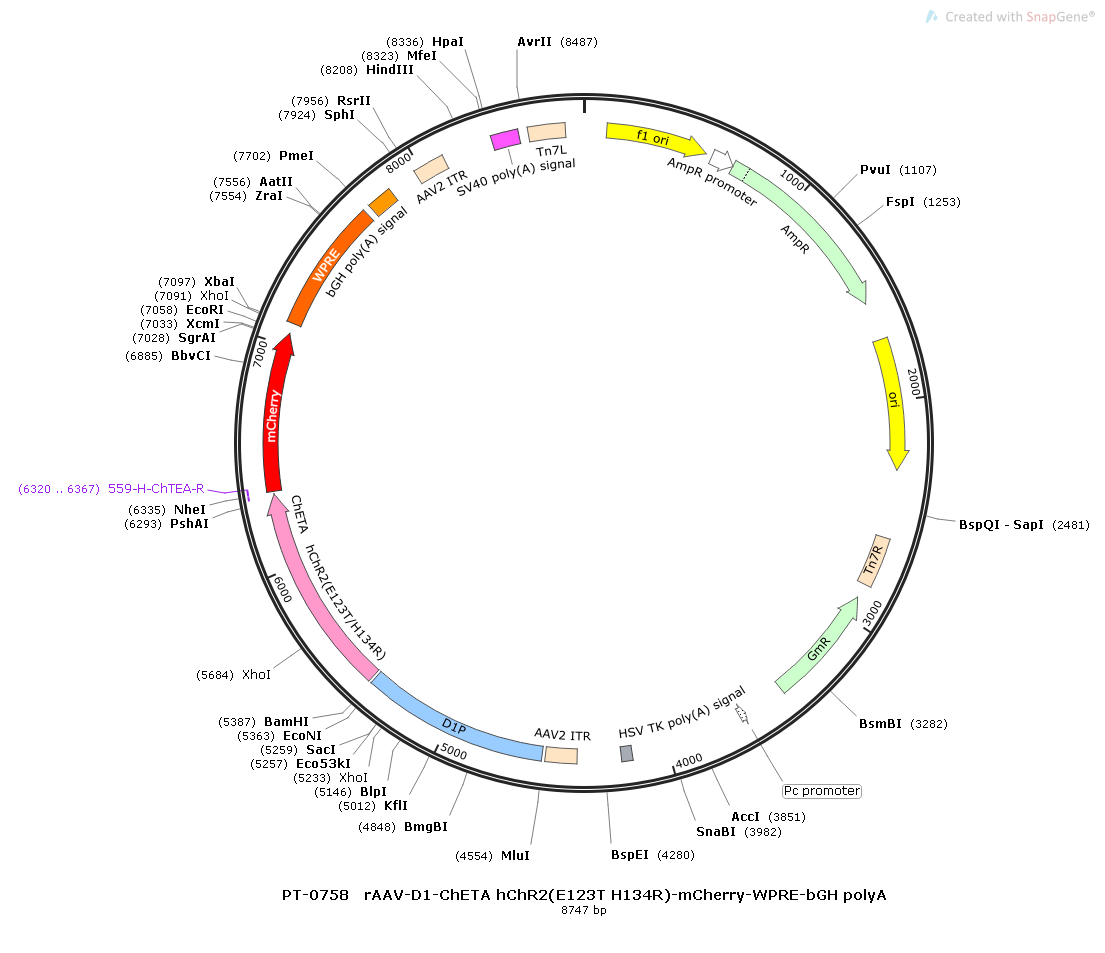
hChR2(E123T/T159C): It is called one of the upgraded versions of ChETA in Karl Deisseroth's laboratory. By introducing the point mutation of T159C, the shortcoming of ChETA's weak inward current has been significantly improved. The inward current in the plateau period is close to hChR2(H134R), while also maintaining the rapid closing characteristics of ChETA molecules, giving the channel excellent properties. Based on the E123T mutation, T159C has a significantly better effect on increasing inward current than H134R. The excitation light wavelength is 473nm, suitable for high-frequency light activation.
hChR2 (H134R): It is the most common form of ChR2. h refers to the coding sequence of the gene that has been optimized for the human codon table. H134R refers to the mutation of histidine at position 134 to arginine. This mutation inhibits the binding of H+ by ChR2 and increases the passage ability of Na+, thereby increasing the overall conductivity of the molecule and thereby increasing the inward current excited by light. Generally, blue light around 470nm is used for excitation.
Fluorescent Tag
EYFP
Fluorescent Protein Details
mCherry: red fluorescent protein, excitation wavelength 587nm, emission wavelength 610nm.
EYFP: Yellow fluorescent protein, excitation wavelength 513nm, emission wavelength 527nm.
Virus Type
adeno-associated virus
Application
Expressing light-sensitive ion channel proteins, such as ChR2, ChrimsonR, etc., in neurons through rAAV viral vectors can specifically excite neurons and explore the effects of light stimulation on neurons, neural circuits and animal behavior.
Regulatory Element Details
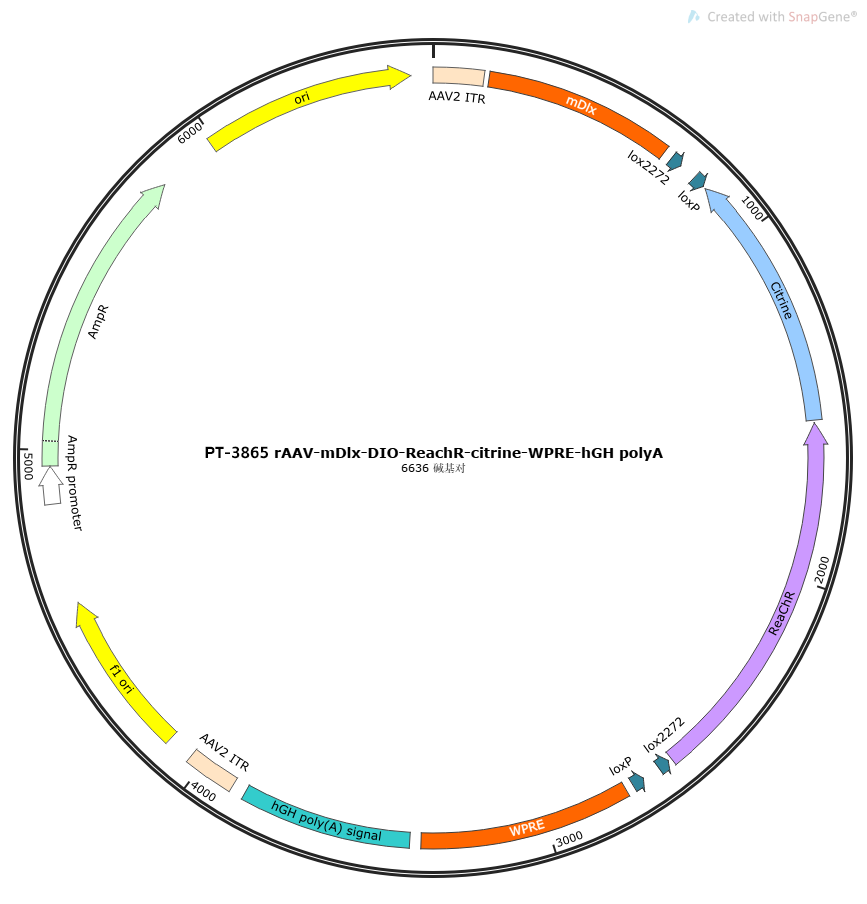
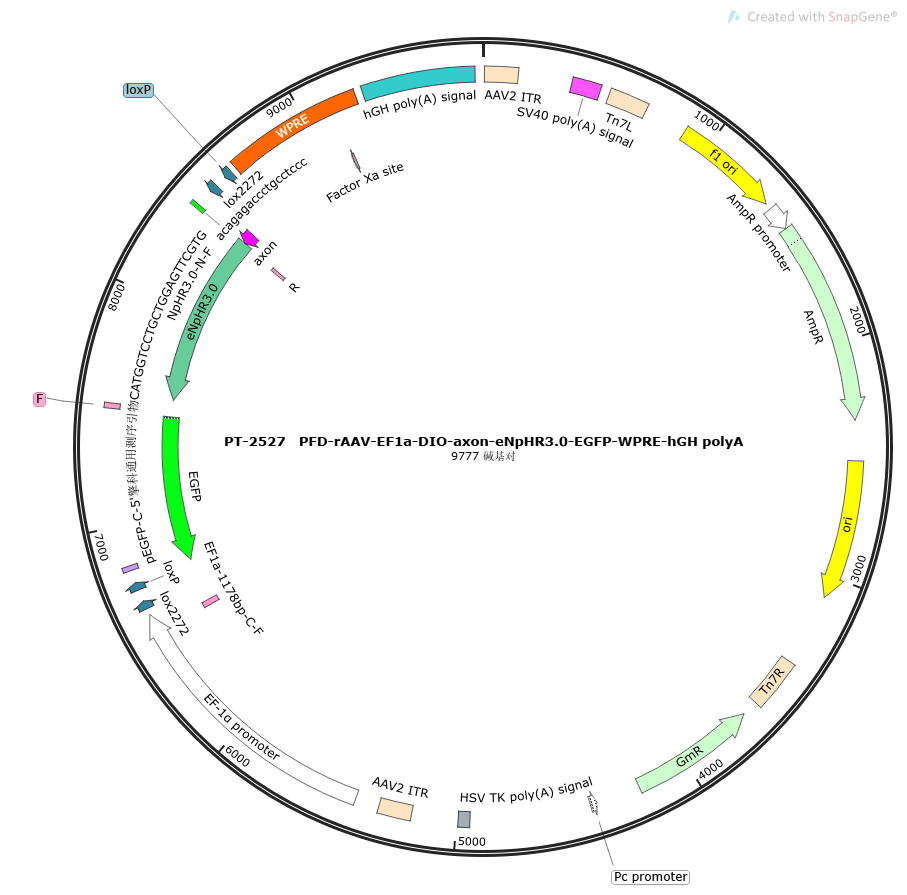
DIO: Double-floxed inverse Orientation, is an element that cooperates with Cre recombinase to control the expression of the target gene. If there is no Cre recombinase, the target gene will not be expressed, but in the presence of Cre, the target gene can be expressed normally.
Localization Element Details
axon: Axonal localization.
Notes
1. Short-term storage at 4°C; long-term storage at -80°C
2. It can be stored at -80°C for more than 6 months. Each time it is frozen and thawed, the titer will be reduced by 10%, and repeated freezing and thawing should be avoided; if the virus is stored for more than 6 months, it is recommended to re-measure the virus titer before use
3. According to the experimental needs, the virus can be appropriately diluted and divided into the volume required for each experiment.