Dual-Layer Strategy
Algorithmic prediction identifies candidate off-target sites, while GUIDE-seq validates real wet-lab editing events to reduce false positives and missed low-frequency events.
Gene Editing Safety Validation
Computational prediction plus wet-lab validation - identify, locate, and characterize off-target edits before you commit to clinical development.
Core Advantages
Use a dual-layer strategy that combines genome-wide computational screening with GUIDE-seq wet-lab validation to support clinical safety decisions.
Algorithmic prediction identifies candidate off-target sites, while GUIDE-seq validates real wet-lab editing events to reduce false positives and missed low-frequency events.
Each off-target event is mapped to genomic coordinates and assessed for proximity to key genes, regulatory regions, or safety-relevant loci.
Off-target sites are classified by risk level and packaged into a report that supports IND safety sections and guide RNA prioritization.
Order as a standalone safety service or embed it into AAV genome optimization and RUO manufacturing projects carrying gene editing payloads.
Editing Safety
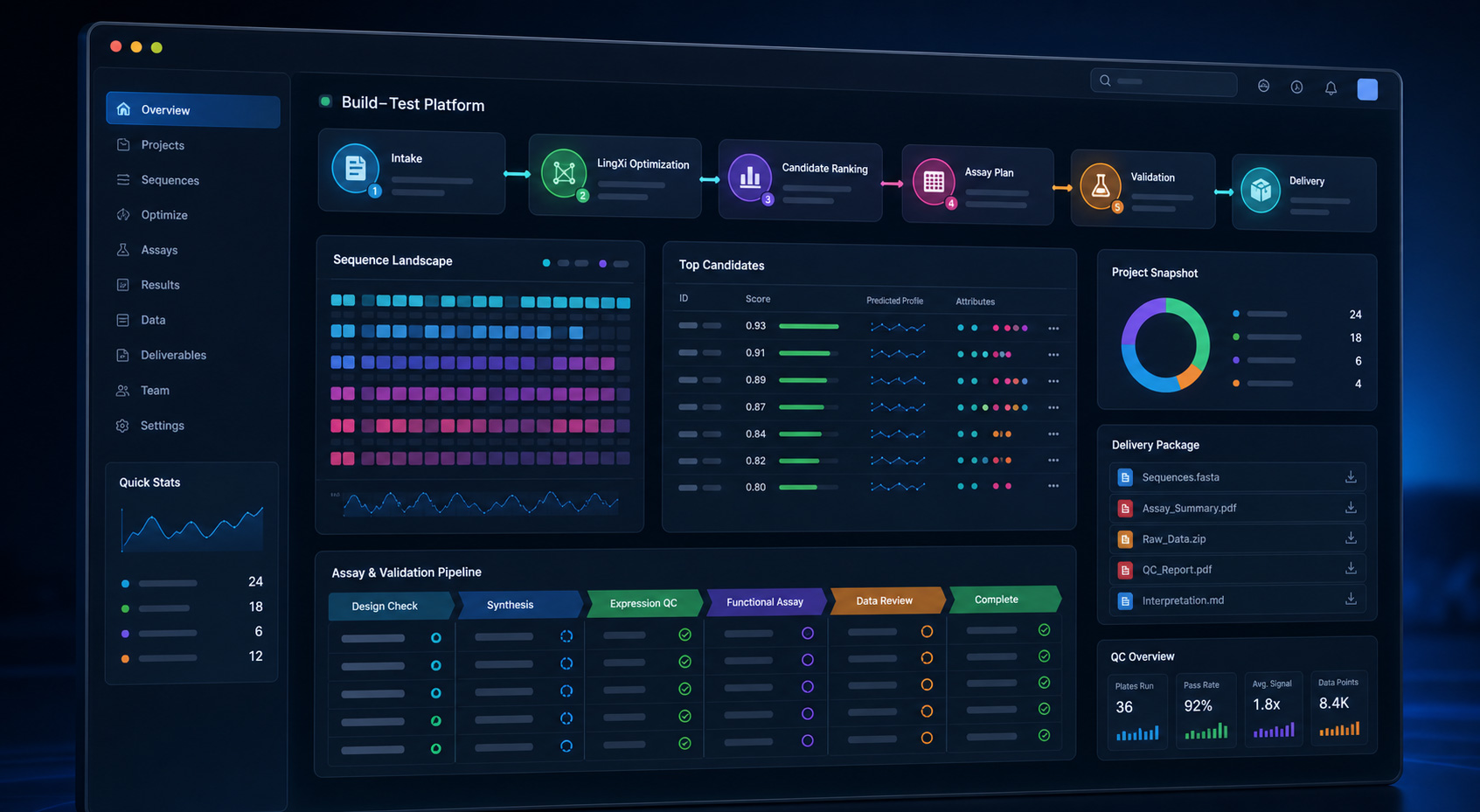
Guide candidates, validation samples, sequencing outputs, and final risk summaries stay connected for therapeutic safety decisions.


Methods & Specifications
Designed to identify potential off-target sites, verify true editing events, and classify functional risk.
| Layer | Method | Role | Description |
|---|---|---|---|
| Layer 1: Algorithmic Prediction | Proprietary prediction plus public-tool cross-checks | Identify candidate off-target sites | Uses sgRNA and genome sequence homology to produce a candidate site list with PAM, mismatch count, and position information. |
| Layer 2: Wet-Lab Validation | GUIDE-seq | Validate true off-target events | Captures genome repair events after nuclease cutting through high-throughput sequencing and maps experimentally verified off-target sites. |
Matched controls help remove background signal and support clear interpretation.
| Sample Type | Description | Requirement |
|---|---|---|
| sgRNA/Cas expression system | Customer gene editing system. | Provide sgRNA sequence, Cas variant information, and expression vector sequence. |
| Edited cell system | Cells treated with the gene editing system. | Provide cell type, editing conditions, and timepoint. |
| Control cells | Untreated matched control cells. | Used for background noise filtering. |
Confidentiality note: specific algorithm models, GUIDE-seq experimental details, and bioinformatics workflow details are not externally disclosed to protect methodology IP.
Workflow
Standard timeline: 4-6 weeks after project confirmation. If GUIDE-seq libraries or sequencing data already exist, the bioinformatics-only workflow can shorten the timeline to 2-3 weeks.
Deliverables
Predicted site list, GUIDE-seq validated results, risk classification, functional impact assessment, method notes, and limitations.
Candidate site coordinates, mismatch count, PAM sequence, risk score, and genomic annotation.
GUIDE-seq verified sites with coordinates, editing frequency, edit type, and genomic annotation.
Raw alignment files for visualization and independent review.
Genome distribution maps, risk-level heatmaps, and editing frequency plots.
Metadata-tagged data for computational pipelines or LIMS import.
Report template: the report structure is designed to align with common FDA and EMA IND expectations for gene editing safety data.
Use Cases
Generate regulatory-ready off-target evidence for CRISPR/Cas9 and other gene editing systems.
Compare candidate sgRNAs by off-target risk profile and choose safer guides before development investment.
Integrate gene editing safety data into AAV vector optimization or RUO project reports.
Use Crossilico as an independent third-party lab for objective off-target risk assessment.
Build Service Integration
FAQ
Off-target editing occurs when a gene editing system cuts DNA at unintended genomic locations. It can create unwanted mutations, rearrangements, or disruption of critical genes, so regulators expect comprehensive safety data before clinical trials.
Prediction tools are useful for screening, but they can create false positives and miss context-dependent events. Our dual-layer strategy combines prediction with GUIDE-seq wet-lab validation to report experimentally confirmed events.
We support CRISPR/Cas9, high-fidelity Cas9 variants, Cas12a, base editors, and prime editors. For non-standard systems, contact us for feasibility review.
Yes. We can analyze samples from species with available reference genomes, including mouse, rat, and non-human primates. In vivo designs require project consultation to define sample collection and depth requirements.
Off-Target Assessment evaluates unintended DNA cuts by the editing system. Integration Risk Assessment evaluates whether the AAV vector integrates into the host genome. For AAV-delivered gene editing systems, both risks are often assessed together.
Yes. If your AAV project involves a gene editing payload, add Off-Target Assessment before project completion so safety data can be integrated into the final project report.
Sensitivity depends on sequencing depth, cell type, and editing efficiency. Detection limits are assessed during project consultation and stated in the final report.
Standard turnaround is 4-6 weeks from project confirmation. Bioinformatics-only analysis from existing GUIDE-seq data typically takes 2-3 weeks.
Standard delivery includes a PDF report, CSV site lists, BAM/CRAM raw sequencing files, and PNG/PDF visualizations. Custom JSON with metadata is available on request.
Yes. The strategy and report structure align with common gene therapy IND expectations for gene editing safety, including predicted and experimentally validated sites, frequency data, and risk assessment.
Start Assessment
Submit your sgRNA and system details for a free feasibility and project consultation. Standalone or bundled with your AAV project - flexible to your needs.