Chemogenetics
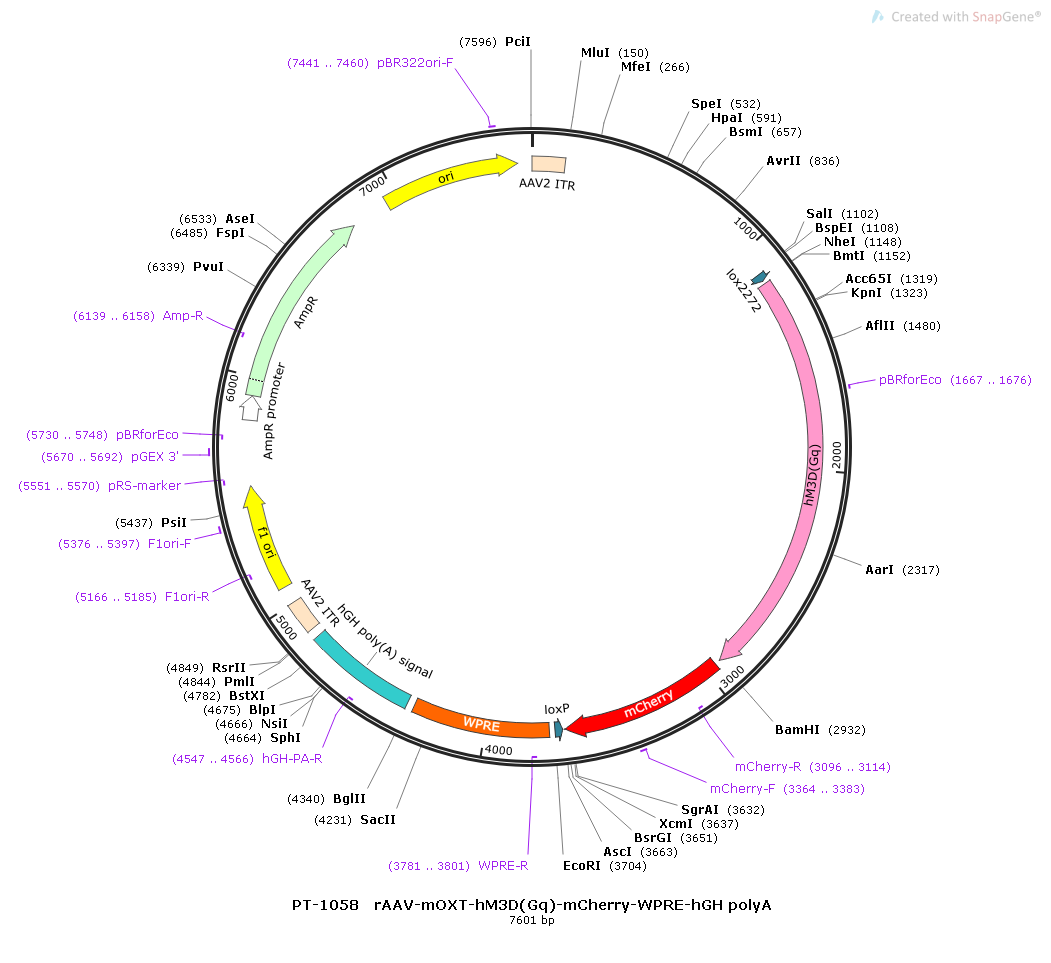
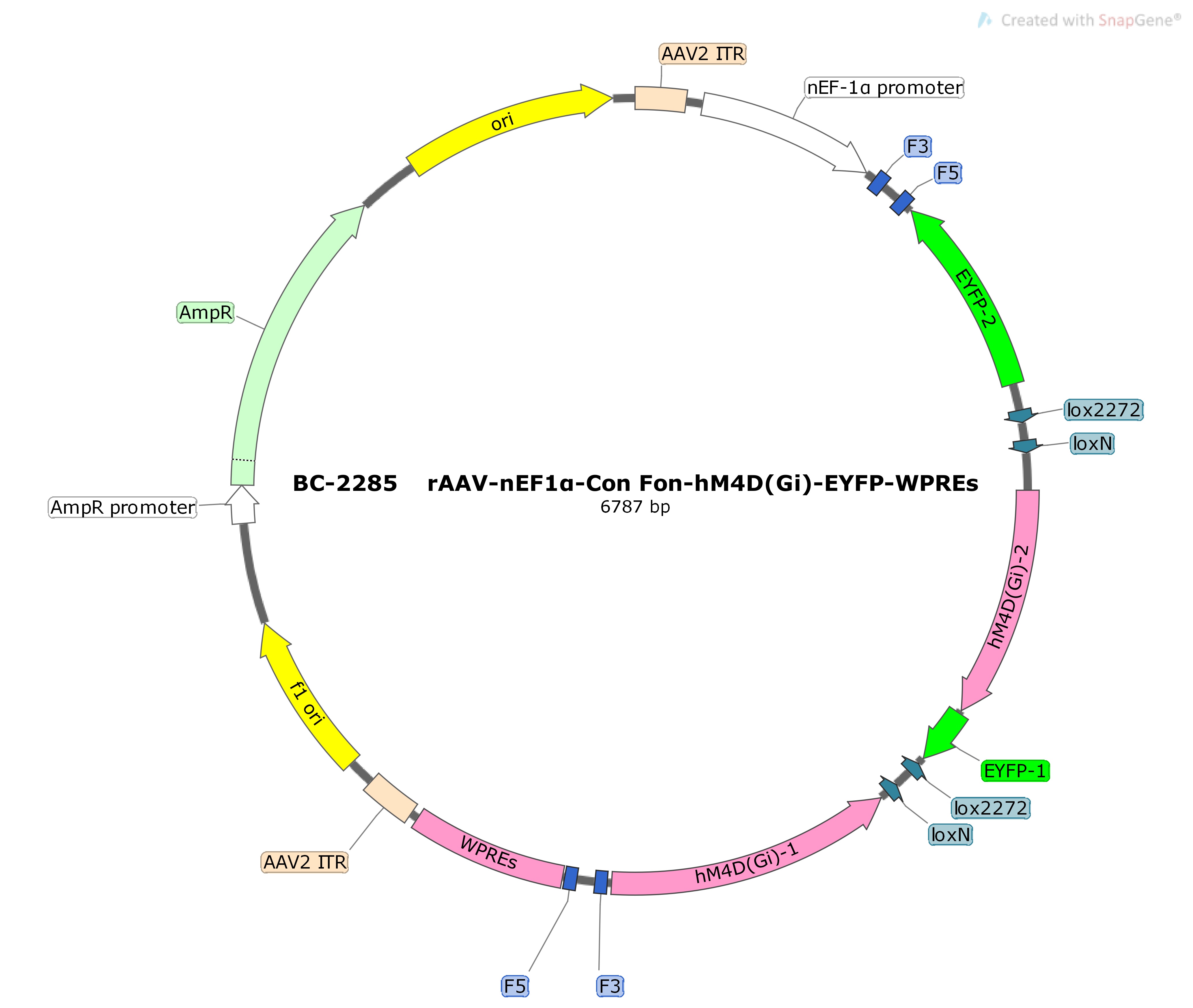
rAAV-hSyn-DIO-hM4D(Gi)-EYFP-WPRE-hGH polyA
The mature neuron-specific promoter hSyn regulates the expression of Cre-dependent chemogenetic repressive elements. hM4D(Gi)-EYFP is expressed in the presence of Cre, but hM4D(Gi)-EYFP is not expressed in the absence of Cre. hM4D(Gi) is another modified human-derived G protein-coupled receptor. After activation with clozapine N-oxide (CNO), it activates the Gi signaling pathway to inhibit cells.
AAV1, AAV2, AAV5, AAV6, AAV8, AAV9, rh10, DJ, B10, PHP.eB, PHP.S, MaCPNS1/2, retro, anc80l65, AAV3, AAV4, AAV11, AAV13, BR1, MG1.AAV2, olig001, 9/retro, Please consult for more serotypes
hM4D(Gi)
hSyn Neuron-specific Promoter
Store at -80°C
Delivery Information
Usually Ships in 7 Business Days;
Product Details
Promoter Details
hSyn, human synapsin promoter, mature neuron-specific promoter, 448bp.
Functional Gene Details
hM4D(Gi): It is an artificial receptor modified from the human muscarinic acetylcholine receptor M4 that only responds to CNO and is no longer activated by acetylcholine. In some neurons, CNO binds to hM4D(Gi) and activates the Gi protein-coupled inward potassium channel GIRK, hyperpolarizing the cell membrane and inhibiting the firing of action potentials in neuronal cells. In cells that do not express GIRK or Gi, hM4D(Gi) functions differently.
Fluorescent Tag
EYFP
Fluorescent Protein Details
EYFP: Yellow fluorescent protein, excitation wavelength 513nm, emission wavelength 527nm.
Virus Type
adeno-associated virus
Application
Chemical genetics technology/DREADDS (designer receptors exclusively activated by designer drugs) technology can be used to regulate the activities of neurons or other types of cells. For example, by injecting the virus into a specific brain area of a mouse, and after hM4D(Gi) is expressed in the mouse, CNO (clozapine-N-oxide, N-oxide clozapine) is given via intraperitoneal injection or diet, which can activate neurons over a long period of time (on the order of hours). DREADDs technology can be used to explore neurons and neural circuits related to memory formation, food intake regulation and arousal.
Regulatory Element Details
DIO: Double-floxed inverse Orientation, is an element that cooperates with Cre recombinase to control the expression of the target gene. If there is no Cre recombinase, the target gene will not be expressed, but in the presence of Cre, the target gene can be expressed normally.
Notes
1. Short-term storage at 4°C; long-term storage at -80°C
2. It can be stored at -80°C for more than 6 months. Each time it is frozen and thawed, the titer will be reduced by 10%, and repeated freezing and thawing should be avoided; if the virus is stored for more than 6 months, it is recommended to re-measure the virus titer before use
3. According to the experimental needs, the virus can be appropriately diluted and divided into the volume required for each experiment.
Expression and Regulation Mode
Cre-dependent