Optogenetics
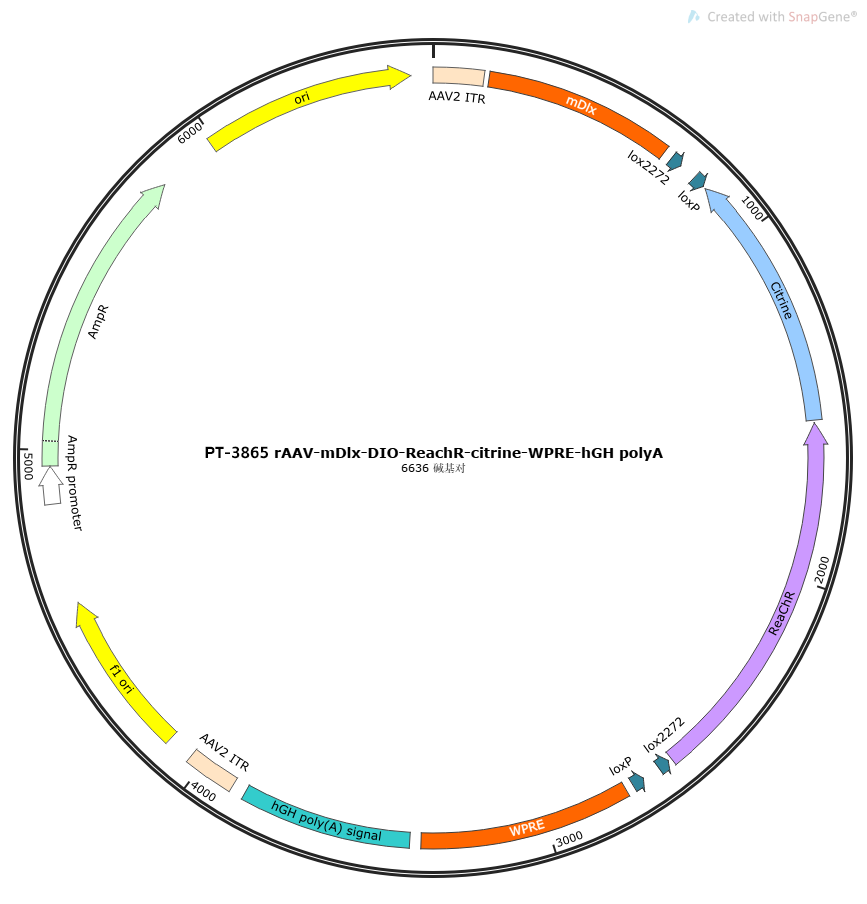
rAAV-EF1α-DIO-ReachR-Citrine-WPRE-hGH polyA
The broad-spectrum promoter EF1α regulates the expression of Cre-dependent light-activated elements. ReachR-citrine is expressed when Cre is present, but ReachR-citrine is not expressed when Cre is absent. This AAV expresses ReaChR-Citrine driven by a neuron CaMKIIα promoter. ReaChR(denoted red-activatable ChR) is a variant of ChR, is optimally excited with orange to red light (λ∼590-630 nm). Compared to existing red-shifted ChRs, it improved membrane trafficking, higher photocurrents and faster kinetics.
AAV1, AAV2, AAV5, AAV6, AAV8, AAV9, rh10, DJ, B10, PHP.eB, PHP.S, MaCPNS1/2, retro, anc80l65, AAV3, AAV4, AAV11, AAV13, BR1, MG1.AAV2, olig001, 9/retro, Please consult for more serotypes
ReachR ReaChR
EF1α Broad-spectrum Promoter
Store at -80°C
Delivery Information
Usually Ships in 7 Business Days;
Product Details
Promoter Details
Ef1α, a strong promoter, human targeted elongation factor 1α (EF1A) gene, can be stably expressed in most types of cells, especially cells where the CMV promoter is silenced, such as stem cells, 1178bp.
Functional Gene Details
ReachR: red-activatable ChR, is an optogenetic tool modified by Tsien's laboratory based on vChR1 that can respond to red light with a wavelength of 590 to 630nm. In the range of 10 Hz and below, cortical neurons expressing ReachR can be directly activated by extracranial light administration. However, ReachR can also be excited by blue light.
Fluorescent Tag
Citrine
Fluorescent Protein Details
Citrine: yellow fluorescent protein, excitation wavelength 516nm, emission wavelength 529nm.
Virus Type
adeno-associated virus
Application
Expressing light-sensitive ion channel proteins, such as ChR2, ChrimsonR, etc., in neurons through rAAV viral vectors can specifically excite neurons and explore the effects of light stimulation on neurons, neural circuits and animal behavior.
Regulatory Element Details
DIO: Double-floxed inverse Orientation, is an element that cooperates with Cre recombinase to control the expression of the target gene. If there is no Cre recombinase, the target gene will not be expressed, but in the presence of Cre, the target gene can be expressed normally.
Notes
1. Short-term storage at 4°C; long-term storage at -80°C
2. It can be stored at -80°C for more than 6 months. Each time it is frozen and thawed, the titer will be reduced by 10%, and repeated freezing and thawing should be avoided; if the virus is stored for more than 6 months, it is recommended to re-measure the virus titer before use
3. According to the experimental needs, the virus can be appropriately diluted and divided into the volume required for each experiment.
Expression and Regulation Mode
Cre-dependent