PCR Primers Design
tNGS Primer Design / Amplicon Sequencing Primer Design
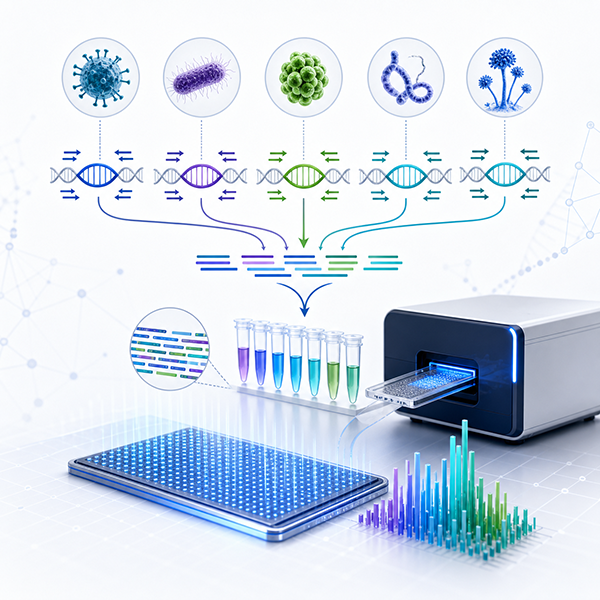
Our tNGS Multiplex Primer Design Service provides high-quality, practical primer design solutions for complex pathogen detection scenarios.
Product Introduction
Our tNGS Multiplex Primer Design Service provides high-quality, practical primer design solutions for complex pathogen detection scenarios.
Designed for targeted NGS (tNGS) applications, the service balances primer specificity, amplification uniformity, and PCR efficiency. It is suitable for clinical testing, microbial research, high-throughput sequencing projects, pathogen panels, resistance gene panels, and targeted microbiome detection.
Core Advantages
1. Reliable Design Based on Authoritative Algorithms
The service uses internationally recognized primer design algorithms, such as the Primer3 engine, combined with multi-parameter optimization strategies.
Primer candidates are systematically screened and scored based on:
- Tm value
- GC content
- Secondary structures, including hairpins and self-dimers
- 3' end stability
- Amplification compatibility
This helps ensure stable performance and high amplification efficiency in real experimental systems.
A layered optimization strategy is also applied:
- Optimal primers are prioritized under strict design conditions
- Parameters can be gradually relaxed when necessary
- The goal is to maximize the chance of obtaining usable primers for every target
2. Integrated Multi-Pathogen and Multi-Target Design
For tNGS applications, the service supports integrated primer design across different pathogen types and target formats.
Supported inputs include:
- Multiple pathogens, including bacteria, viruses, fungi, and parasites
- Multiple gene loci
- Batch FASTA sequences
- Multi-target detection panels
The design workflow enables a unified primer system for:
- Multiplex PCR compatibility
- High-throughput library preparation
- Panel-level design, from dozens to hundreds of targets
Typical applications include:
- Infectious disease detection panels
- Antimicrobial resistance gene panels
- Targeted microbiome detection
- Clinical pathogen screening
- Microbial research projects
3. Comprehensive Pairwise Primer Comparison to Reduce Dimer Risk
All candidate primers are evaluated through comprehensive pairwise comparison to improve multiplex PCR stability.
Screening includes:
- Primer-primer cross-dimer analysis
- Self-dimer detection
- 3' end complementarity risk assessment
- Compatibility evaluation across the full primer set
Through strict threshold filtering, the service helps minimize:
- Primer-dimer formation
- Non-specific amplification
- Amplification bias
- Competition between primer pairs
This improves the stability, uniformity, and reliability of multiplex PCR systems for tNGS workflows.