PCR Primers Design
MLPA Probe Design Service (Self-Developed Platform)
MLPA Probe Design Service provides fast, accurate, and synthesis-ready probe design solutions for multiplex ligation-dependent probe amplification applications.
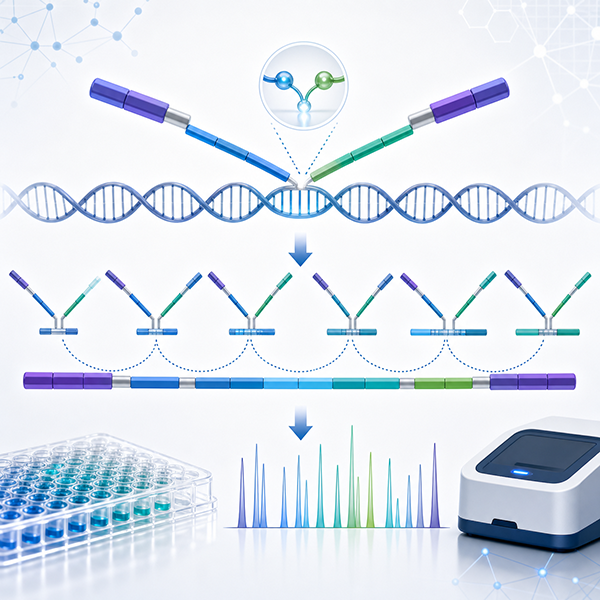
Product Introduction
Our MLPA Probe Design Service provides fast, accurate, and synthesis-ready probe design solutions for multiplex ligation-dependent probe amplification applications.
With a self-developed software platform and extensive experience in molecular biology and bioinformatics, we focus on delivering standardized MLPA probe structures that can be directly used for oligonucleotide synthesis. The service is suitable for precise detection of copy number variation, exon deletion, point mutation analysis, and other targeted molecular assays.
Service Highlights
1. Self-Developed Intelligent Design System
Our in-house design system enables efficient and automated MLPA probe construction.
The system can automatically assemble:
- Left probe arms
- Right probe arms
- Universal primer sequences
- Stuffer sequences
- Complete probe structures
This reduces manual sequence assembly errors and improves design efficiency.
2. Flexible Input Formats for Different Detection Scenarios
The service supports multiple input formats to match different project requirements.
Supported input types include:
- FASTA sequences
- Ligation site coordinates
- Target region information
- Custom detection targets
This allows flexible probe design for different genes, regions, and assay purposes.
3. Clear and Standardized Probe Structure
Each designed probe follows a clear and standardized MLPA structure.
Output advantages include:
- Well-defined probe components
- Standardized formatting
- Direct use for oligonucleotide synthesis
- No manual sequence splicing required
- Reduced risk of formatting or assembly mistakes
Why Choose Us
1. Self-Developed Algorithm Tailored to Experimental Needs
Our algorithm is built around real experimental requirements, helping improve probe usability, structural rationality, and detection reliability.
2. Standardized Output for Easier Probe Synthesis
The final probe format is organized and synthesis-ready, making downstream ordering and validation more efficient.
3. Flexible Design for Multiple Application Types
The service can be adapted to different MLPA applications, including:
- Exon deletion detection
- Copy number variation analysis
- Point mutation detection
- Gene region screening
- Targeted clinical or research assays